The first time I worked up the nerve to put my head underwater as a kid, it felt like I had entered another dimension. Everything is quieter underwater, and slower, and gravity is negotiable. I basically prefer water to air, so a good chunk of my summer vacations growing up were spent at the neighborhood pool.
For the most part, I did a lot of stuff people normally do at the pool. I was on the swim team, I learned diving board tricks, I frequented the snack bar for Airhead Xtremes, and I played Marco Polo and make-believe games with my friends. However, being a bug lover, I also spent a considerable portion of my time saving tiny animals that had fallen into the water, most notably bees, mulch lobsters, and millipedes.
While the bees and the mulch lobsters were a yearly sight, the millipedes went away after our first couple years as pool members. Nevertheless, I still think about them every time I wander over to the shallow end. These were garden millipedes: thin, brown, inch-long diplopods with white legs and underbellies. Garden millipedes release a smelly liquid from their armpits and curl up like tiny cinnamon rolls when they’re scared, which is just one of the many reasons why they are unarguably adorable. To learn more about how wonderful (albeit smelly) millipedes in general are, check out the Millipedes vs. Centipedes post.
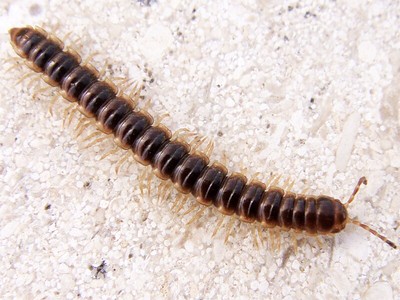
Unlike most millipedes, garden millipedes don’t have eyes. They use their antennae to get around instead, so I can’t really blame them for stumbling into the pool. They’re also a lot less colorful and intricate than most other species in the “dragon millipede” family, Paradoxosomatidae. Yeah, trying saying that times three fast! Or once, at normal speed. I’m trying to sound it out as I type this and it’s not happening.
I really like the name “dragon millipede” though, especially since it’s much easier to pronounce than paradox-whatever, so I’m renaming garden millipedes “pool dragons.” Hold all applause til the end of the post, please.
Because pool dragons aren’t native to North America and can adapt well to otherwise unwelcoming ecosystems, they’re pretty common in urban areas. Unfortunately, they have few if any natural predators here and multiply quickly, so it’s not exactly thrilling when you find they’ve decided to colonize your garage. Like other diplopods, however, pool dragons don’t bite and pose no threat to humans, so they’re more of a nuisance than a health issue even when they infest homes or public areas. They also seem more likely to populate outdoor areas like patios and greenhouses (hence their “greenhouse millipede” nickname) than to actually form colonies in buildings. However, if it gets too hot outside, they have been known to come indoors. Or take a dip in the pool, apparently.
My family stopped renewing our pool memberships when I was in high school. Although it’s been a while now, I still miss the days when I could just walk up the road on a hot day and go for a swim. I miss my swim team, the diving boards, the Krispy Kreme donuts our coach would bring the morning after a swim meet… maybe most of all, I miss diving into the deep end and staring up at the sky from the bottom of the pool. Some of the best daydreams take shape underwater.
…And some of the best daydreams are rudely interrupted when you notice a mulch lobster or pool dragon crawling around nine feet underwater and you have to carry it back to the surface before it drowns itself.
I love arthropods, but sometimes they can be kinda stupid.
 Home
Home 